ORCA AI and ARIA: AI-Enabled Static Security for Maritime and Critical Infrastructure
Enhancing Awareness Across Ports, Wharves, Offshore Assets and Sensitive Remote Locations
Australia’s maritime, energy and critical infrastructure environments are becoming more complex, more exposed and more strategically important.
Ports, wharves, offshore facilities, oil and gas fields, offshore wind farms, reefs, islands and culturally sensitive remote places all require stronger situational awareness. Many of these locations are difficult to monitor because they are remote, exposed to harsh environmental conditions, spread across large areas or dependent on limited communications and response resources.
ARIA Project Management Solutions works with ORCA AI to help clients understand how AI-enabled maritime awareness, computer vision and sensor-supported decision-making can be applied to static installation security and critical infrastructure protection.
This capability is relevant to organisations seeking to improve:
- maritime domain awareness
- perimeter and exclusion-zone monitoring
- vessel and small craft detection
- remote site visibility
- port and wharf security
- offshore infrastructure protection
- environmental and cultural site awareness
- operational decision support
- incident review and response coordination
ARIA’s role is to help translate ORCA AI’s maritime technology into practical, client-specific capability outcomes.
Why Static Installation Security Needs Are Changing
Traditional security models often rely on cameras, patrols, radar, access control, manual observation and incident reporting. These remain important, but they can be difficult to scale across maritime and remote environments.
Many fixed-site maritime locations face common challenges:
- large areas of water or coastline to monitor
- variable weather, sea state and visibility
- unauthorised vessel approaches
- complex interactions between commercial, recreational and operational traffic
- exposure from the sea, shoreline and adjacent infrastructure
- remote or lightly staffed locations
- limited ability to maintain continuous human observation
- environmental and cultural sensitivity
- delayed response times in isolated areas
For critical infrastructure operators, the challenge is no longer simply collecting more data. The challenge is turning sensor inputs into timely, trusted and actionable awareness.
AI-enabled maritime situational awareness can help operators detect, classify, prioritise and respond to activity around fixed assets and sensitive locations.
AI-Enabled Maritime Awareness in Action
ORCA AI applies artificial intelligence and computer vision to maritime environments to enhance situational awareness and support decision-making. Its technology is designed to help users better understand what is occurring around vessels and within complex maritime operating environments.
For ARIA clients, this capability is particularly relevant to ports, wharves, offshore infrastructure, energy assets, protected waters and remote sites where early detection, classification and decision support can improve operational confidence.
ORCA AI’s technology demonstrates how artificial intelligence, computer vision and integrated sensing can enhance maritime awareness across large, complex and difficult-to-monitor environments.
For ARIA clients, this capability is particularly relevant to ports, wharves, offshore infrastructure, energy assets, protected waters and remote sites where early detection, classification and decision support can improve operational confidence.
While the video demonstrates maritime awareness in a Defence-oriented context, the same capability themes are highly relevant to static installation security. Ports, wharves, offshore energy assets, wind farms, reefs, islands and culturally sensitive locations all require improved visibility, timely alerting and trusted decision support.
ARIA helps clients assess how this type of capability can be translated into practical operating models, trials, governance arrangements and implementation pathways.
ORCA AI maritime awareness capability overview — supporting detection, classification and decision support across complex maritime environments.
While the video demonstrates maritime awareness in a Defence-oriented context, the same capability themes are highly relevant to static installation security. Ports, wharves, offshore energy assets, wind farms, reefs, islands and culturally sensitive locations all require improved visibility, timely alerting and trusted decision support.
ARIA helps clients assess how this type of capability can be translated into practical operating models, trials, governance arrangements and implementation pathways.
The ORCA AI Capability
ORCA AI’s technology supports enhanced maritime awareness through the application of AI, computer vision and integrated sensing. Public information from ORCA AI describes its platform as supporting safer navigation, improved decision-making and better situational awareness in complex maritime environments.
For static installation security, these same capability themes can be considered in a fixed-site context.
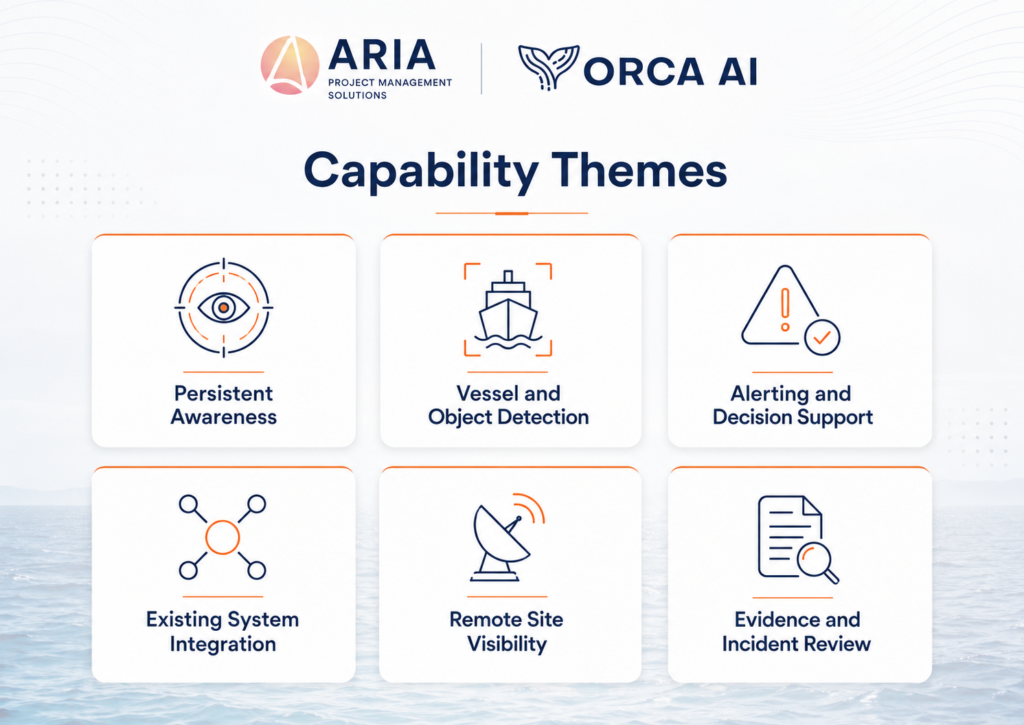
Persistent Situational Awareness
AI-enabled sensing can help maintain awareness across defined areas of interest, including harbour approaches, wharf zones, exclusion areas, offshore infrastructure, mooring areas, protected waters and restricted maritime zones.
Vessel and Object Detection
Computer vision and sensor integration can support the detection of vessels, small craft, floating objects or other activity that may require review, escalation or response.
Alerting and Decision Support
Rather than relying solely on continuous manual monitoring, AI-enabled systems can assist operators by highlighting activity that may require attention.
Integration with Existing Operations
The capability can be considered alongside existing CCTV, radar, AIS, access control, command centers, patrol vessels, security teams and operational procedures.
Enhanced Maritime Domain Visibility
For operators managing assets near water, ORCA AI’s maritime focus provides an opportunity to strengthen visibility across the surrounding sea-space.
Where This Capability Can Apply
ORCA AI-enabled maritime awareness can be considered across a range of fixed-site and remote operating environments where improved detection, visibility and decision support are required.
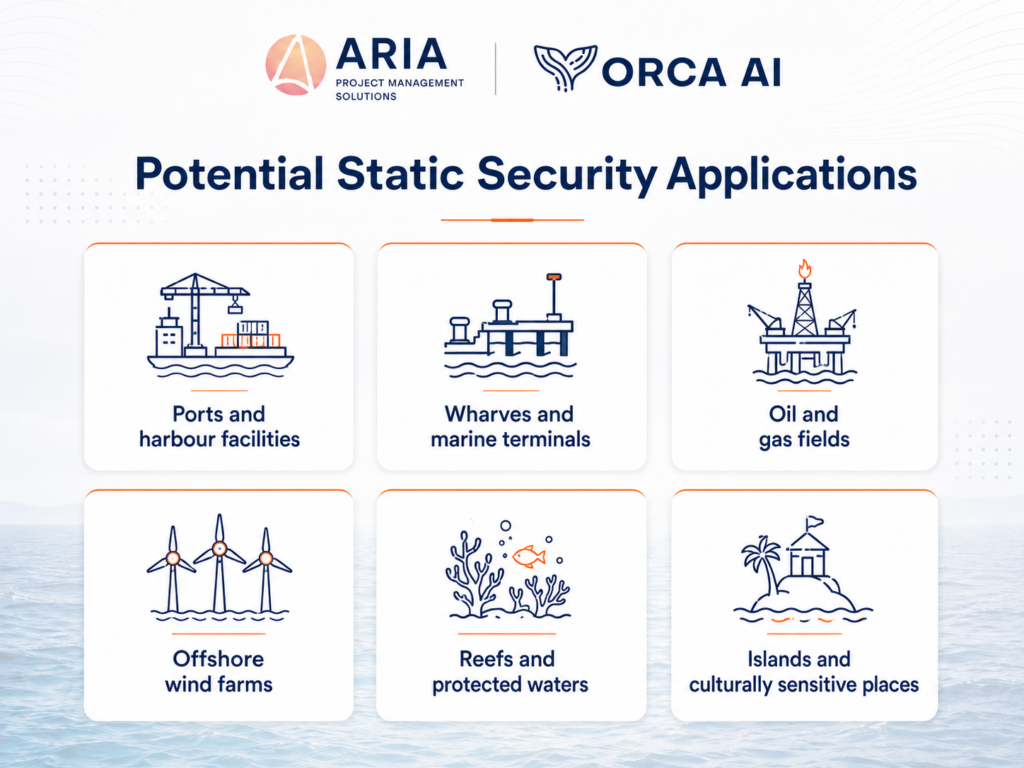
Potential static security applications for ORCA AI-enabled maritime awareness across ports, wharves, offshore energy assets, protected waters and sensitive remote locations.
Ports and Harbour Facilities
Ports are busy, complex environments involving commercial shipping, tugs, pilotage, workboats, recreational craft, restricted areas and landside infrastructure.
AI-enabled monitoring may assist with:
- harbour approach awareness
- wharf and berth monitoring
- restricted area observation
- unauthorised vessel detection
- after-hours surveillance
- support to port security operations
- improved incident review and reporting
Wharves, Jetties and Marine Terminals
Wharves, jetties and marine terminals are exposed from both land and water. Operators must manage vessel movements, people, cargo, safety, security and environmental risk.
Potential applications include:
- monitoring of vessel approaches
- awareness of exclusion zones
- detection of unusual activity near berths
- support for remote or lightly staffed facilities
- visual augmentation of existing systems
- support for security and operations teams
Oil and Gas Fields
Offshore and nearshore oil and gas infrastructure may include platforms, subsea assets, export terminals, pipelines, floating assets and support vessel operations.
AI-enabled maritime awareness may support:
- monitoring around offshore infrastructure
- detection of vessels near exclusion zones
- support to marine coordination teams
- improved awareness for safety and security
- operational control-room integration
- evidence capture for incident review
Offshore Wind Farms and Renewable Energy Assets
As Australia’s offshore renewable energy sector develops, the security and monitoring of offshore wind farms and associated infrastructure will become increasingly important.
Potential applications include:
- monitoring vessel activity around turbines
- supporting construction and operations phases
- awareness of advisory or exclusion zones
- asset protection during remote operations
- integration with marine operations centres
- support to safety, security and environmental management
Reefs, Islands and Environmentally Sensitive Areas
Some locations are not traditional infrastructure sites but still require protection. Reefs, islands, marine parks and remote ecological areas may be vulnerable to unauthorised access, illegal anchoring, vessel intrusion or environmental disturbance.
AI-enabled monitoring may assist with:
- observation of protected waters
- detection of unauthorised vessel activity
- support for ranger, environmental or compliance teams
- monitoring of remote or hard-to-access areas
- evidence capture for incident review
- protection of fragile ecosystems
Culturally Sensitive and Isolated Places of Importance
Remote coastal, island and marine locations may hold cultural, heritage or community significance. These places may require respectful monitoring approaches that support Traditional Owners, custodians, government agencies and site managers.
Potential applications include:
- monitoring access to culturally sensitive areas
- supporting agreed protection protocols
- providing awareness without unnecessary physical intrusion
- assisting remote custodianship and site management
- supporting culturally informed response arrangements
- enabling better evidence and reporting when incidents occur
ARIA recognises that technology must be applied carefully in these settings. Any proposed solution should be developed with appropriate cultural engagement, governance, privacy consideration and respect for Traditional Owner priorities.
From Maritime Awareness to Static Security Capability
ORCA AI’s maritime AI capability provides the technology foundation. ARIA helps clients translate that technology into an operating model that is practical, governable and aligned with site-specific needs.
ARIA helps clients move from technology interest to a structured, practical and governable capability pathway.
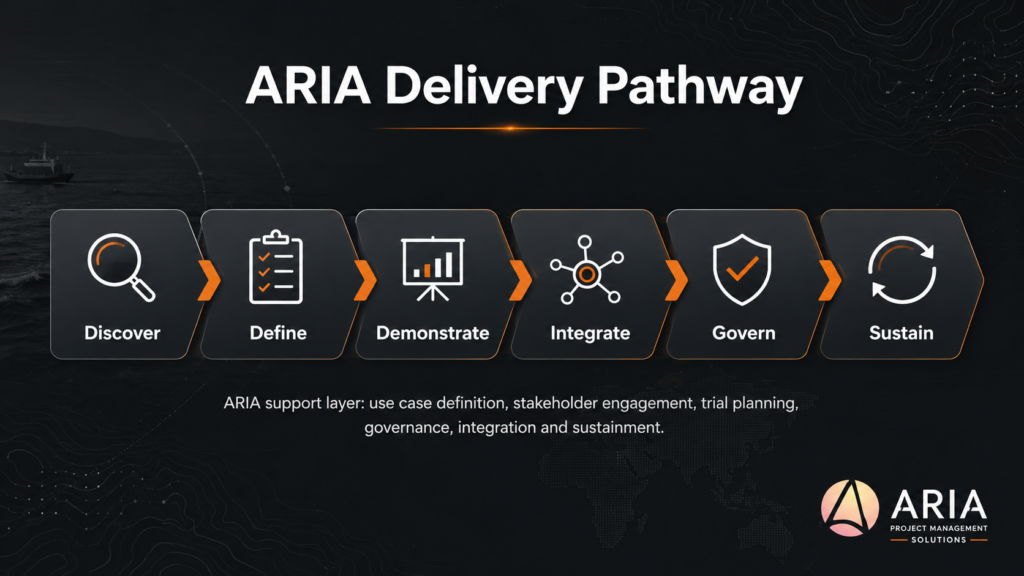
ARIA delivery pathway for translating ORCA AI-enabled maritime awareness into practical static security capability.
The transition from technology interest to operational capability usually requires six steps:
1. Discover
Understand the site, operating environment, stakeholder needs, security risks and existing systems.
2. Define
Develop clear use cases, operational scenarios, detection priorities, response requirements and success measures.
3. Demonstrate
Plan a practical demonstration or trial that allows the client to assess relevance, performance and operational fit.
4. Integrate
Consider how the capability connects with existing security systems, operations centres, communications, patrols and procedures.
5. Govern
Establish requirements for human oversight, privacy, cyber security, data handling, cultural sensitivity, assurance and accountability.
6. Sustain
Develop the support, training, maintenance, review and continuous improvement arrangements needed for long-term use.
Practical Client Scenarios
Port Security Enhancement
A port operator wants to improve awareness of vessel movements near restricted wharf areas after hours.
ARIA can support the client to define operational zones, existing controls, priority risks, response arrangements and trial objectives. ORCA AI-enabled maritime awareness can then be considered as part of a broader port security enhancement model.
Offshore Energy Asset Protection
An offshore energy operator wants improved visibility around remote infrastructure.
ARIA can help develop use cases for exclusion-zone monitoring, vessel detection, control-room integration and operational response planning.
Sensitive Island or Reef Protection
A government agency, environmental manager or Traditional Owner group wants to improve awareness of unauthorised vessel access near a protected or culturally significant location.
ARIA can support a culturally informed engagement and governance process, ensuring that any technical solution aligns with custodial expectations, privacy requirements and agreed response protocols.
Offshore Wind Farm Development
A renewable energy developer wants to improve maritime awareness across an offshore development area during construction and operations.
ARIA can help define how AI-enabled monitoring could support construction safety, marine coordination, security, environmental management and long-term asset protection.
Why ARIA
ARIA brings experience across Defence, maritime sustainment, project delivery, procurement, asset management, systems thinking, governance and emerging technology translation.
ARIA is well placed to help clients answer the practical questions that determine whether technology becomes useful capability:
- What problem are we trying to solve?
- What are the operational risks?
- What does success look like?
- What systems need to integrate?
- Who responds to alerts?
- What governance is required?
- How should a trial be structured?
- How does the capability scale?
- What sustainment model is needed?
This delivery-focused approach helps clients move from interest in AI to a clear, structured pathway for adoption.
A Responsible Approach to AI-Enabled Security
AI-enabled security and monitoring must be implemented responsibly.
ARIA supports a practical governance approach that considers:
- human accountability
- privacy and data handling
- cultural and environmental sensitivity
- cyber security
- operational safety
- false positives and false negatives
- escalation procedures
- evidence management
- system assurance
- operator training
- long-term sustainment
For critical infrastructure and sensitive locations, trust is as important as technical performance.
Explore AI-Enabled Static Security for Your Site
Static installation security is not just about seeing more. It is about understanding what matters and acting at the right time.
Through the ARIA–ORCA AI relationship, clients can explore how AI-enabled maritime situational awareness may support stronger protection of ports, wharves, offshore infrastructure, renewable energy assets, remote islands, reefs and culturally sensitive places.
ARIA can support early-stage discussions, capability discovery, operational use case development, trial planning and implementation pathways for clients considering ORCA AI-enabled maritime security solutions.
Contact ARIA to discuss how AI-enabled situational awareness can support your port, wharf, offshore asset, remote site or critical infrastructure operation.