Technology Readiness Levels: A Proven Foundation
Technology Readiness Levels (TRLs) remain one of the most widely used frameworks for assessing the maturity of technology. Originating from NASA and adopted globally, including across the Australian Defence ecosystem, TRLs provide a structured method for evaluating whether a technology is ready to transition into capability.
At their core, TRLs answer a critical question:
Is this technology mature enough to be integrated into a system without unacceptable risk?
For decades, this has been essential in Defence, where large, complex platforms require confidence in performance, integration, and sustainment before significant investment is committed.
Why TRLs Still Matter for the ADF
In the context of the Australian Defence Force (ADF) and major capability programs, TRLs continue to play a vital role:
- Supporting risk-informed decision making
- Structuring capability development pathways
- Aligning with systems engineering and assurance frameworks
- Providing a common language across Defence, industry, and government
Within the National Defence Strategy (NDS) and the emerging Integrated Investment Program (IIP) 2026, there is a clear emphasis on:
- Accelerated capability delivery
- Sovereign industrial capability
- Rapid acquisition pathways
- Continuous capability evolution
In this environment, TRLs remain important—but they are no longer sufficient on their own.
The Shift: From Maturity to Adaptation
The nature of modern conflict, and therefore Defence capability, has changed.
Recent operational environments, including lessons observed in Ukraine, highlight a fundamental shift:
- Capability is increasingly software-defined
- Systems are modular, distributed, and rapidly replaceable
- Platforms are becoming more attritable and consumable
- The battlefield rewards speed of adaptation, not just technical maturity
This challenges the traditional TRL model, which assumes:
- A linear progression from concept to deployment
- A focus on maturity before fielding
- Deployment as the end of development
That model is now being inverted.
Deployment is no longer the end of development—it is part of development itself.
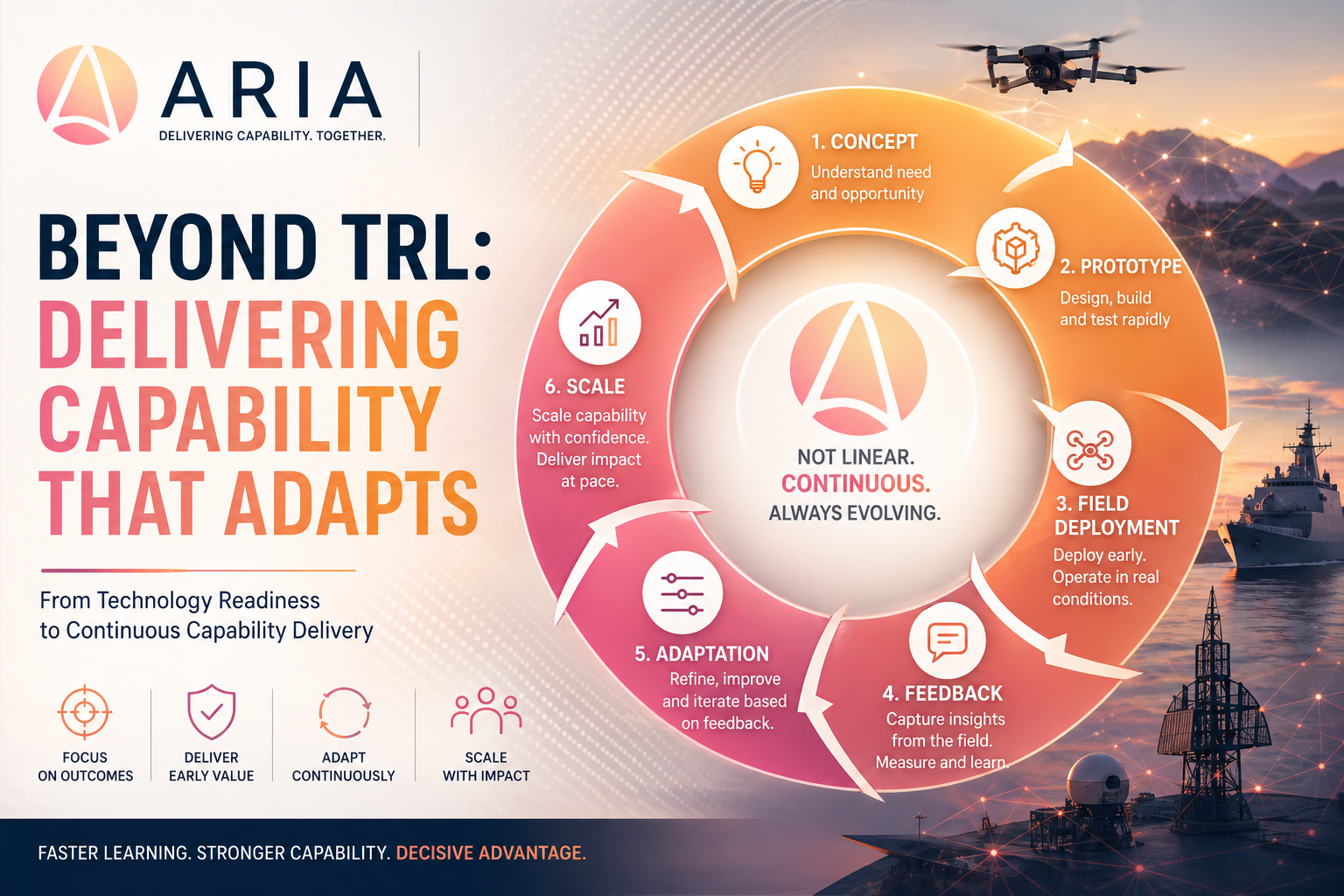
From Technology Readiness to Capability Delivery
The shift from linear technology maturity to continuous capability adaptation is best understood as a system, not a sequence.
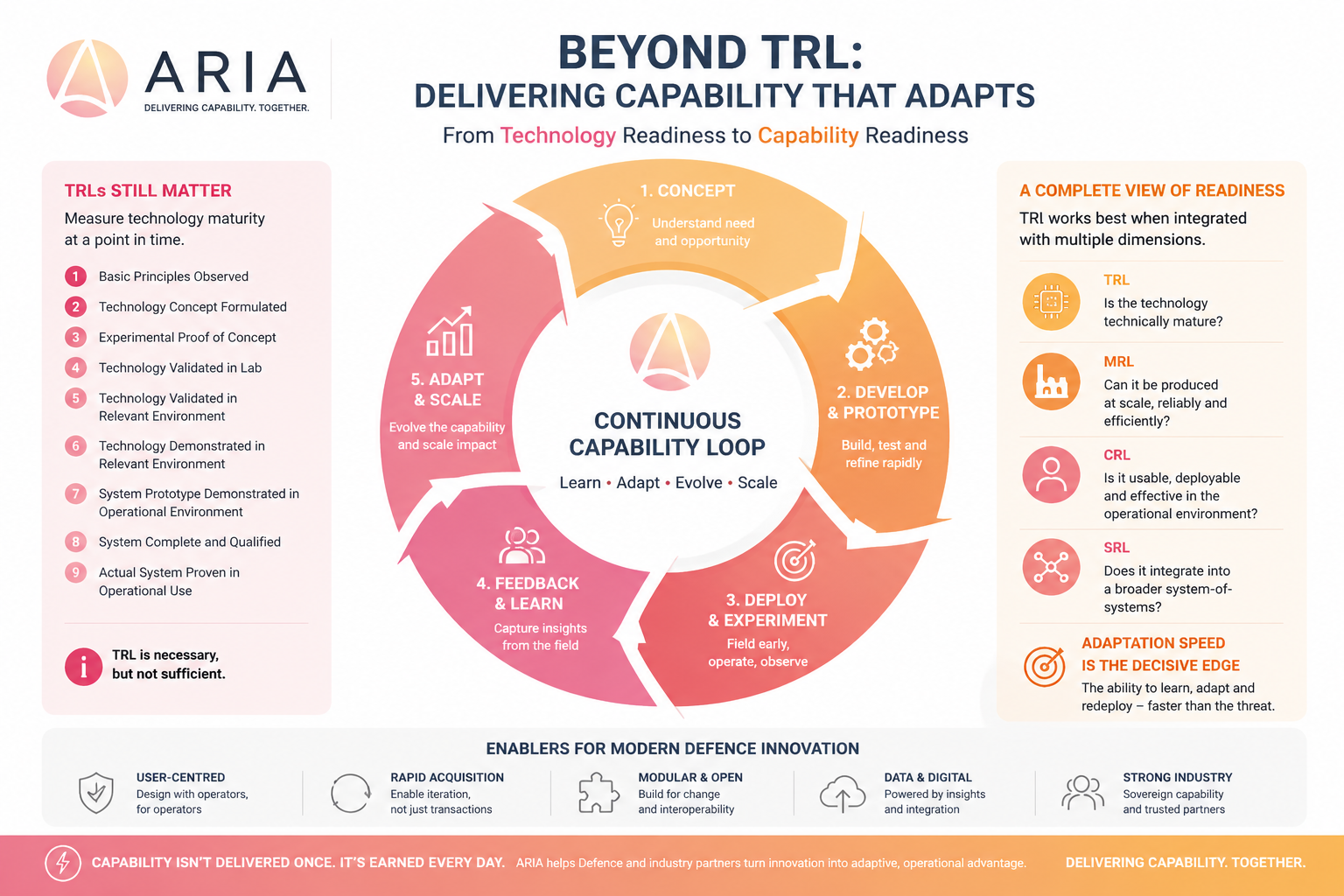
This model reflects the reality facing modern Defence capability programs, where deployment, feedback, and adaptation occur in continuous loops, supported by multiple dimensions of readiness.
The Limitation of TRL Alone
TRLs measure maturity at a point in time.
They do not adequately measure:
- How quickly a system can adapt in the field
- Whether it can be produced at scale
- If it is usable in real operational conditions
- How effectively it integrates into a broader capability system
In other words:
TRL measures readiness. The modern battlefield rewards adaptability.
This creates a critical gap—one that Defence organisations globally are now working to close.
A More Complete View of Readiness
Rather than replacing TRLs, the emerging consensus is to expand the readiness framework.
A more complete approach integrates multiple dimensions:
1. Technology Readiness (TRL)
- Is the technology technically mature?
2. Manufacturing Readiness (MRL)
- Can it be produced at scale, reliably and efficiently?
3. Customer / Capability Readiness (CRL)
- Is it usable, deployable, and effective in the operational environment?
4. System Readiness (SRL)
- Does it integrate into a broader system-of-systems?
Beyond Readiness: The Rise of Adaptation Speed
The defining variable in modern Defence capability is increasingly:
How fast can a system learn, adapt, and be redeployed?
This aligns strongly with:
- Agile and iterative development models
- Rapid prototyping and field experimentation
- Continuous integration of user feedback
- Software-driven capability evolution
It also reflects a broader shift toward:
- Minimum viable capability (MVC) over fully mature systems
- Short lifecycle systems rather than decades-long platforms
- Learning loops embedded within operational deployment
Implications for Defence Procurement and the IIP 2026
If Defence is to realise the intent of the National Defence Strategy and IIP 2026, procurement and delivery models must evolve accordingly.
Key implications include:
1. TRL Should Inform Decisions—Not Gate Them
Over-reliance on requiring TRL 9 before deployment slows capability delivery and limits innovation.
2. Procurement Must Support Iteration
Procurement should enable:
- Rapid acquisition
- Incremental upgrades
- Continuous capability refinement
3. Industry Must Deliver More Than Technology
Capability must be:
- Scalable (MRL)
- Usable (CRL)
- Integrated (SRL)
4. Innovation Must Be Connected to Deployment
Funding, development, and procurement must operate as a connected system, not sequential stages.
An ARIA Perspective: From TRL to Capability Readiness
At ARIA, we see TRLs as a necessary but incomplete tool.
The challenge is not that TRLs are outdated—it is how they are used.
The real opportunity is to move from “Technology Readiness” to “Capability Readiness.”
This requires integrating:
- Technical maturity
- Production capability
- Operational usability
- System integration
- Adaptation and learning speed
A Practical Model for Modern Capability Development
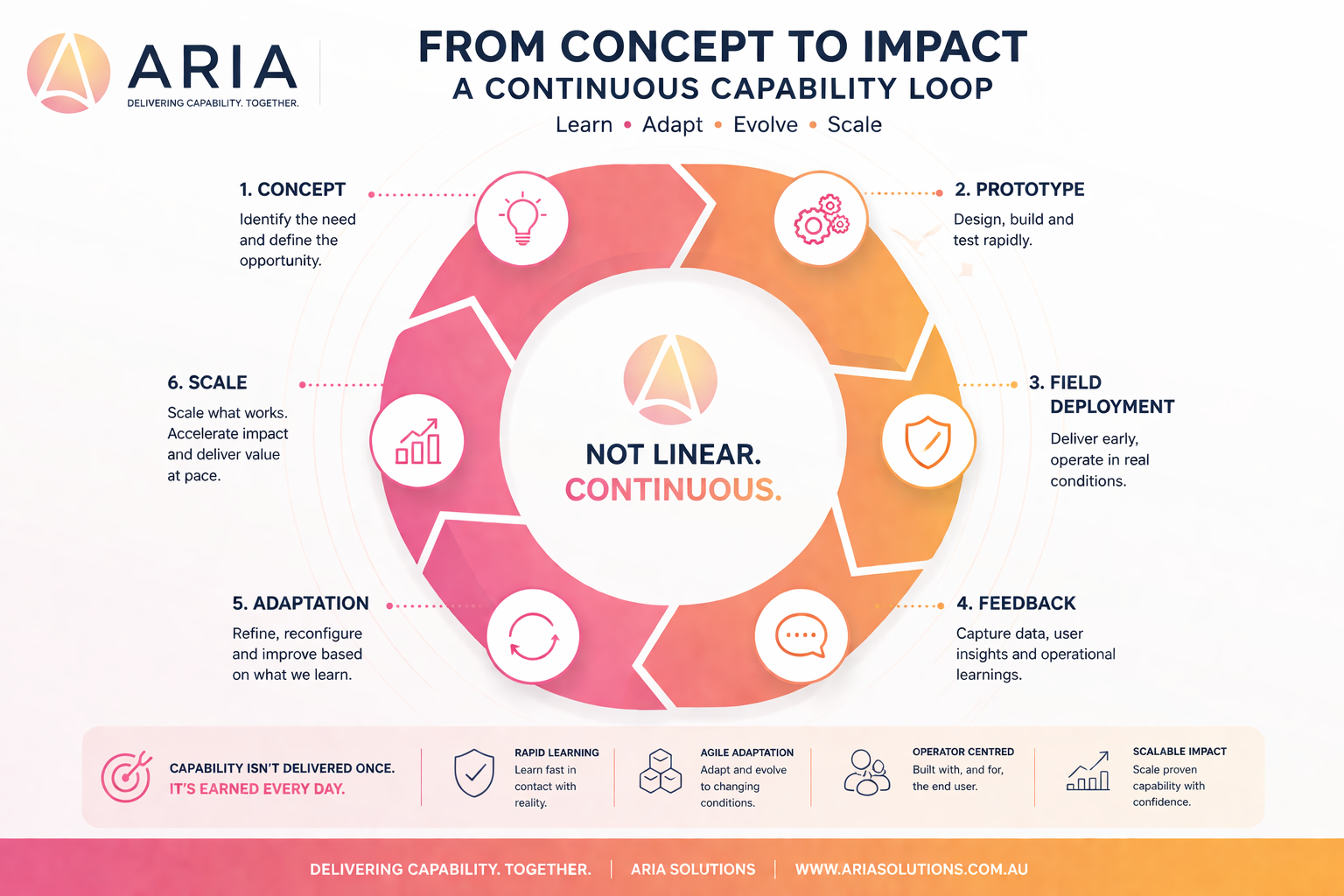
Supported by:
- TRL (Technology maturity)
- MRL (Production readiness)
- CRL (Operational usability)
- SRL (System integration)
Conclusion: TRL Isn’t Dead, But It Has Evolved
Technology Readiness Levels remain a critical foundation within Defence capability development.
However, in the context of modern warfare and strategic competition:
- Maturity alone is no longer decisive
- Speed of adaptation is now critical
- Capability must evolve in contact with reality
The organisations that succeed will not simply be those with the most mature technologies—
They will be those that can learn, adapt, and deliver capability fastest.
Position Your Capability for Delivery
ARIA works with Defence, government, and industry partners to:
- Translate emerging technologies into deployable capability
- Navigate TRL, MRL, and capability readiness frameworks
- Support rapid acquisition and delivery models
- Align innovation with ADF operational needs and strategic priorities

Leave a Reply