
Innovation rarely fails because of a lack of ideas. It fails because the path from concept to real-world use is poorly understood. […]
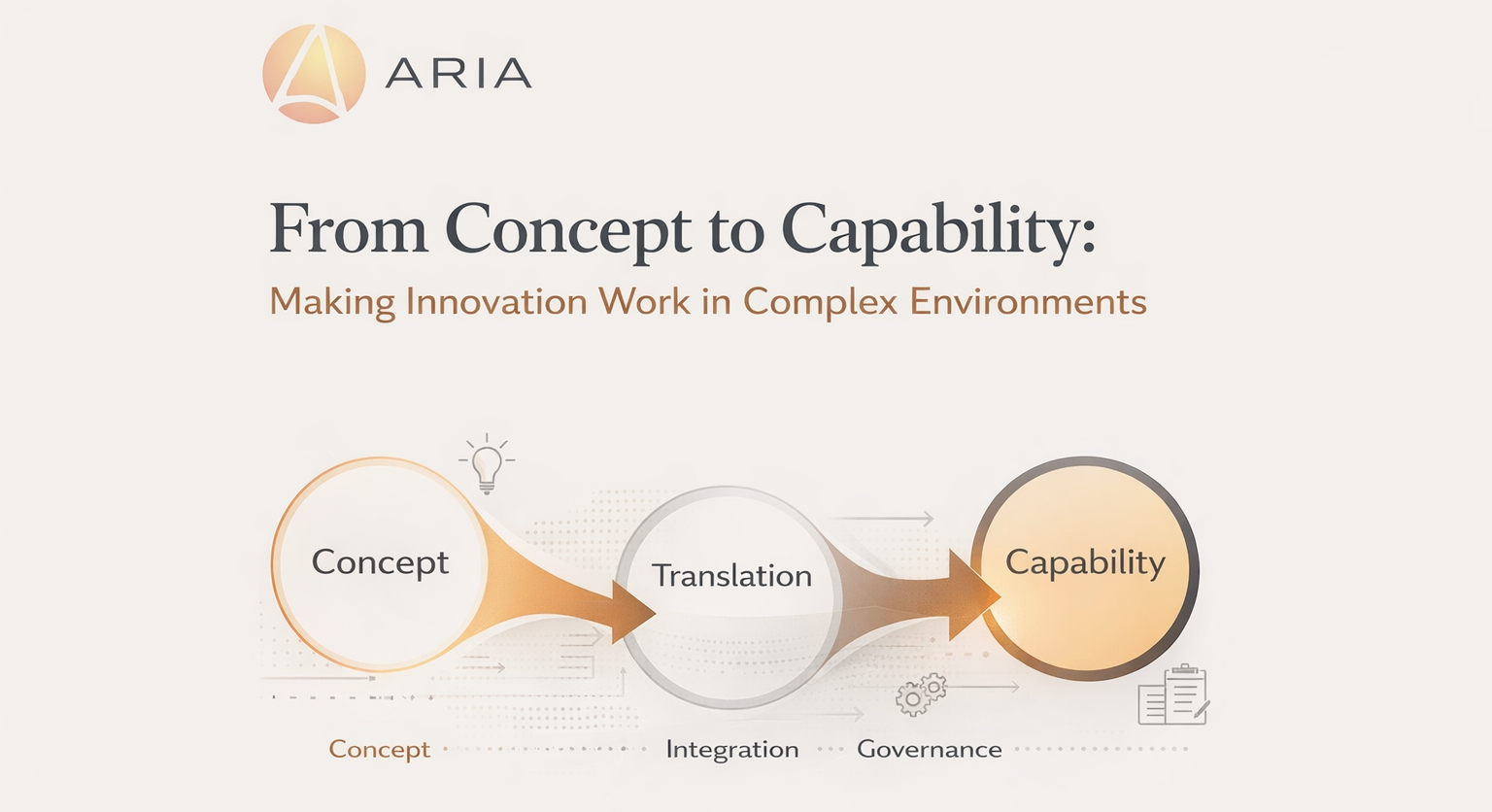
Why innovation succeeds or fails in regulated environments — and how translation bridges the gap.
Innovation rarely fails because of a lack of ideas.
It fails because the path from concept to real-world use is poorly understood.
In Defence, government, and other regulated environments, good ideas often stall not on technical merit, but on questions of assurance, integration, governance, and adoption. This is particularly true where systems are complex, consequences are high, and decisions must be defensible.
At ARIA, we work at the intersection of innovation and delivery. Our focus is not on novelty for its own sake, but on helping ideas become deployable, supportable capability.
Innovation is Not the Same as Capability
A common misconception is that once a technology works, adoption will follow. In reality, operational environments demand much more.
For an idea to become capability, it must be:
- Clearly aligned to an operational or organisational need
- Able to integrate with existing systems and processes
- Supportable over time, not just demonstrable once
- Governed, assured, and defensible in decision-making
Without these elements, even promising innovations struggle to progress beyond pilots or demonstrations.
Why Translation Matters
Translation is the discipline of moving an idea from what could be to what can be used.
This involves more than technical refinement. It requires:
- Framing the problem in capability terms
- Understanding stakeholder expectations and constraints
- Designing trials that answer real adoption questions
- Considering sustainment, training, and lifecycle early
In regulated environments, translation is not optional. It is the difference between innovation that is interesting and innovation that is adopted.
Delivery Discipline Enables Innovation
There is sometimes a perceived tension between innovation and delivery: that structure slows creativity, or that governance inhibits experimentation.
In practice, the opposite is often true.
Clear delivery discipline enables innovation by:
- Providing decision-makers with confidence
- Reducing risk through staged progression
- Ensuring evidence is gathered in a meaningful way
- Making adoption easier, not harder
When innovation is paired with delivery thinking from day one, it becomes easier to scale, integrate, and sustain.
Common Barriers to Adoption
Across Defence, government, and industry, several barriers appear repeatedly:
- Undefined ownership — no clear transition from pilot to business-as-usual
- Late consideration of sustainment — supportability treated as an afterthought
- Misaligned incentives — success measured by demonstration, not use
- Over-technical framing — capability benefits not clearly articulated
Addressing these early dramatically improves the likelihood of successful adoption.
A Practical Path Forward
A more effective approach to innovation in complex environments includes:
- Start with the operational problem, not the technology
- Design pilots to answer adoption questions, not just technical ones
- Engage delivery, assurance, and sustainment stakeholders early
- Treat translation as a discipline, not an administrative step
This approach does not slow innovation. It makes it stick.
Where ARIA Fits
ARIA works with founders, researchers, universities, and technology-driven organisations to support this translation journey.
Our role is not to replace innovation teams, but to help them navigate the realities of complex environments — aligning ideas with governance, delivery, and real-world use.
By combining delivery discipline with innovation translation, we help ensure that good ideas are not only advanced, but adopted and sustained.
About ARIA
ARIA Project Management Solutions is an Australian advisory and delivery firm operating at the intersection of government, Defence, industry, and emerging technology. We support organisations facing complex delivery and capability challenges.

Leave a Reply