AI at Sea: From Situational Awareness to Maritime Defence Advantage
ARIA & Orca AI – Delivering AI-Enabled Maritime Capability Across Australia
DEFENCE • MARITIME SECURITY • AI • AUTONOMY • DOMAIN AWARENESS
A Changing Maritime Operating Environment
The maritime domain is becoming more complex, contested, and less predictable, particularly across the Indo-Pacific region.
For Australia, this directly impacts:
- Maritime Domain Awareness (MDA)
- Border protection and sovereignty enforcement
- Protection of critical infrastructure and offshore assets
- Naval operations across distributed and contested environments
Recent incidents involving GNSS interference and spoofing have demonstrated that positioning data can no longer be assumed to be reliable.
When this occurs, crews revert to:
- Radar
- Visual observation
- Procedural experience
In low visibility or high-density environments, this introduces operational risk. Situational awareness degrades, workload increases, and decision-making becomes more constrained.
Introducing the ARIA + Orca AI Partnership
ARIA Project Management Solutions is now a Channel Partner for Orca AI, supporting capability deployment across:
- Australian Defence Force (ADF), including Royal Australian Navy operations
- Australian Border Force (ABF) and Maritime Border Command
- Maritime security and border protection operations
- Naval and autonomous systems
- Ports, offshore infrastructure, and critical maritime assets
The focus is not the technology itself.
It is the integration of AI into operational maritime capability.
AI provides an independent layer of awareness when positioning data becomes unreliable.
Operating When Positioning Systems Degrade
GNSS disruption is no longer an edge case.
When positioning data is unreliable:
- AIS information may be distorted or misleading
- Vessel position confidence is reduced
- The shared operational picture breaks down
In these conditions, crews are required to interpret incomplete or conflicting information under time pressure.
AI-enabled perception introduces an independent reference layer, allowing crews to:
- Maintain continuous awareness of surrounding traffic
- Detect inconsistencies between sensor inputs
- Identify potential risks earlier
This does not replace existing systems. It stabilises decision-making when those systems degrade.
This is particularly relevant for border protection, littoral operations, and congested port approaches, where ambiguity in the operational picture introduces immediate risk.
Extending the Limits of Traditional Systems
Conventional navigation tools each have limitations:
- Radar performance degrades in cluttered or congested environments
- AIS depends on cooperative transmission
- Human vision is constrained by visibility, fatigue, and workload
AI-enabled perception addresses these constraints through:
- Multi-spectral electro-optical and thermal sensing
- Continuous object detection and classification
- Contextual analysis of vessel behaviour
- Prioritisation of relevant targets
This enables crews to focus on what matters most, rather than managing excessive or ambiguous inputs.
AI-Enabled Digital Watchkeeper
In degraded or low-visibility conditions, maintaining situational awareness becomes increasingly difficult.
AI-Assisted Detection in Low Visibility Conditions
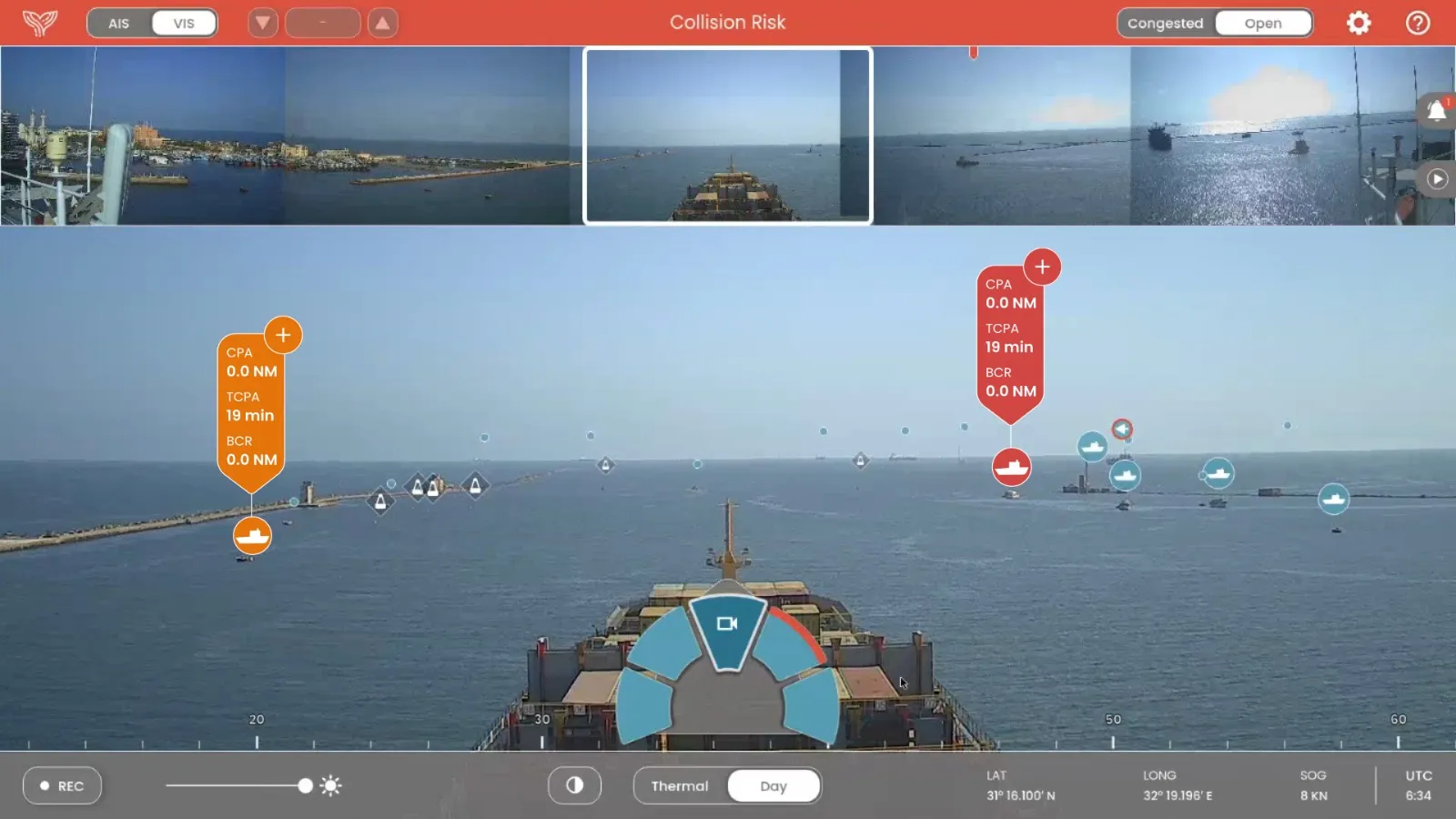
AI-enabled perception provides continuous awareness of surrounding traffic, supporting earlier detection, classification, and response in low visibility conditions.
AI does not replace the bridge watchkeeping team.
It provides an additional layer of perception and context, allowing crews to identify developing risks earlier and act with greater confidence.
From Awareness to Decision Timing
The primary shift is not increased visibility alone, but earlier understanding of developing situations.
Operational use has shown:
- Detection of small or non-cooperative vessels earlier than visual confirmation
- Identification of vessel intent prior to manoeuvre
- Improved navigation performance in low visibility conditions
This provides crews with additional time to:
- Assess risk
- Adjust course or speed
- Maintain safe separation
The outcome is more stable and deliberate decision-making under pressure.
Orca AI Defence Architecture: A System of Systems
Orca AI’s Defence capability extends beyond individual vessels into a fully integrated maritime awareness ecosystem.
It combines fixed infrastructure, mobile assets, and AI-driven command intelligence into a unified operational picture.
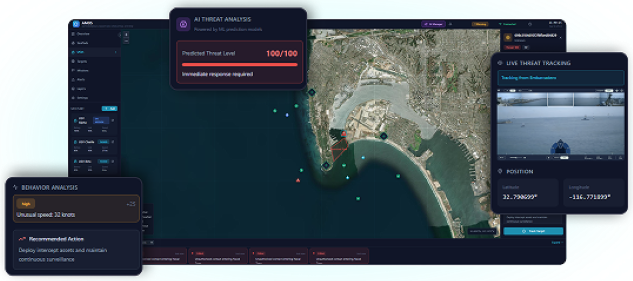
Integrated maritime awareness architecture combining shore-based (Sentinel), vessel-based (Beacon), and command-level (AMOS) AI systems.
1. Sentinel – Persistent Shore-Based Awareness
Sentinel provides fixed, passive monitoring across critical maritime environments, including:
- Shorelines and maritime borders
- Ports, harbours, and vessel traffic approaches
- Naval bases and defence precincts
- Offshore oil and gas platforms
- Subsea and energy infrastructure corridors
Operating continuously, Sentinel delivers:
- Electro-optical and infrared (EO/IR) detection and tracking
- AI-driven situational awareness and threat reasoning
- Behaviour and intent analysis, not just object detection
- Persistent monitoring across wide geographic areas
This enables early identification of:
- Non-cooperative or AIS-silent vessels
- Unusual vessel behaviour near critical infrastructure
- Emerging risks within port and offshore environments
Outcome:
A persistent baseline awareness layer supporting national maritime security, border integrity, and protection of critical maritime assets.
2. Beacon – Mobile & Autonomous Maritime Perception
Beacon extends this capability to vessels and mobile platforms, including:
- Patrol vessels
- Naval assets
- Uncrewed surface vessels (USVs)
It enables:
- Multi-spectral detection, classification, and tracking
- Real-time behavioural analysis and intent prediction
- Autonomous collision avoidance and navigation support
- Edge-based AI processing for resilient, low-latency operation
Beacon is designed to operate in degraded and contested environments, supporting:
- GPS-denied navigation
- Autonomous or assisted vessel control
- Integration with existing fleet systems
Beacon is particularly applicable to patrol vessels, offshore security platforms, and distributed naval operations, where maintaining awareness under degraded conditions is critical.
Outcome:
Enhanced manoeuvre, awareness, and decision-making — even when traditional systems are compromised.
3. AMOS — Intelligent Maritime Orchestration
At the system level, AMOS provides AI-enabled command and control integration across the maritime domain, supporting a shared operational picture across Defence, border protection, and civilian maritime stakeholders.
It delivers:
- A unified operational picture across vessels, shore systems and unmanned assets
- Real-time fusion of distributed sensor data
- Continuous tracking and prioritisation of threats
- Actionable intelligence for decision-makers
By integrating multiple data sources into a single coherent view, AMOS enables:
- Faster, more informed decisions
- Coordinated responses across assets and agencies
- Scalable maritime awareness across large regions
Outcome:
See earlier. Decide faster. Act with precision.
Applicable across ports, offshore platforms, and maritime border operations.
Maintaining Situational Awareness in Low Visibility
In low visibility and congested environments, the ability to detect and track surrounding traffic becomes increasingly constrained using traditional methods alone.
Operational Example:
AI-enabled perception maintains continuous awareness of surrounding traffic, supporting early detection, classification, and response in low visibility and high-density environments.
This provides an additional layer of perception for the command and watchkeeping teams, enabling earlier understanding of developing situations and more stable decision-making under pressure.
From Platforms to Networks
Maritime operations are shifting from platform-centric awareness to networked intelligence.
With connected systems:
- Vessels can access information beyond their immediate surroundings
- Conditions along planned routes can be understood earlier
- Operators gain visibility across multiple assets simultaneously
This enables:
- More proactive voyage planning
- Improved coordination between vessels and shore
- Reduced reliance on single-source data
Human-Centric Integration
AI-enabled systems are most effective when integrated to support, not replace, operators.
Key impacts include:
- Reduced cognitive load on bridge teams
- Improved clarity in complex environments
- Greater confidence in decision-making
- Enhanced training through replay of real operational events
The objective is not automation for its own sake.
It is better-informed human decision-making.
In addition to operational support, these systems contribute to training, assurance and incident investigation functions. Recorded operational data enables replay of real-world scenarios to support bridge team training, mission rehearsal, and post-incident analysis, both at sea and ashore.
This supports continuous improvement, strengthens procedural compliance, and provides an evidence base for operational and safety assurance.
Implications for Australia
For Defence and maritime security stakeholders across Australia, these capabilities directly support:
- Maritime Domain Awareness (MDA) across coastal and offshore regions
- Border protection and sovereignty enforcement operations
- Naval operations in distributed and contested environments
- Protection of ports, offshore energy assets and critical infrastructure
- Increased resilience against GNSS disruption and electronic interference
- Training and operational readiness across maritime forces
- Incident investigation and evidence-based assurance
This aligns with broader national priorities in delivering sovereign capability, including:
- Sovereign capability development
- Integrated maritime surveillance and response
- AI-enabled operational systems across Defence and Border Force environments
Operational Use Cases Across Defence and Maritime Security
AI-enabled maritime perception and decision-support capability can be applied across a range of operational environments relevant to Australia.
Australian Defence Force (ADF)
Supports naval operations across distributed and contested environments, including:
- Enhanced awareness in low visibility and dense traffic
- Detection of non-cooperative or AIS-silent vessels
- Support to autonomous and uncrewed systems
- Decision-making under degraded navigation conditions
Australian Border Force (ABF) & Maritime Border Command
Strengthens border protection and sovereignty enforcement through:
- Detection and tracking of vessels operating without AIS
- Improved awareness in littoral and near-coastal environments
- Early identification of anomalous vessel behaviour
- Enhanced operational response in complex and congested maritime zones
Ports and Maritime Infrastructure
Supports safe and secure port operations and vessel movements, including:
- Monitoring of vessel traffic approaches and harbour environments
- Early identification of navigation risks in congested waterways
- Enhanced visibility during low visibility conditions (fog, night operations)
- Support to vessel traffic services (VTS) and port authorities
Offshore Energy and Critical Maritime Assets
Provides persistent awareness around offshore platforms and infrastructure, including:
- Monitoring of vessel activity near oil and gas platforms
- Detection of unauthorised or unusual vessel approaches
- Protection of subsea and energy infrastructure corridors
- Improved safety and incident prevention in remote offshore environments
These use cases demonstrate how AI-enabled perception extends beyond navigation safety, supporting broader operational, security and infrastructure protection outcomes.
ARIA’s Role: From Capability to Deployment
Delivering operational capability requires more than technology.
It requires integration, assurance and alignment with operational environments.
ARIA supports:
- Integration into existing operational environments
- Alignment with Defence governance and assurance requirements
- Implementation across pilot, transition and scale
- Embedding into operational workflows and training systems
From concept to operational capability.
Deploy AI-Enabled Maritime Capability
ARIA works with Defence, government, and industry to integrate advanced technologies into operational environments.
Final Observation
AI is already being applied at sea.
The key difference is no longer access to technology.