AI GOVERNANCE • SYSTEMS INTEGRATION • DEFENCE DELIVERY
Defence Sets the Direction for Responsible AI
The Australian Department of Defence has formally released its Policy Settings for the Responsible Use of Artificial Intelligence, establishing a clear and necessary framework for how AI will be adopted across Defence capability, operations, and sustainment.
At its core, the policy confirms three critical principles:
- AI will be actively adopted across Defence
- Implementation will follow a risk-based governance model
- Human accountability will remain central to all AI-enabled decisions
This is not a pause on AI adoption—it is a signal that Defence is moving from experimentation to structured, operational integration.
What the Policy Means for Defence Programs
The policy introduces a fundamental shift in how capability must be designed, delivered, and assured.
1. AI Becomes Core to Capability Delivery
AI is no longer peripheral or experimental. It is becoming embedded within:
- Decision-support systems
- Intelligence and data environments
- Platform sustainment and maintenance systems
- Supply chain and logistics optimisation
For Defence and industry, this means AI must now be treated as core capability infrastructure, not an add-on.
2. Risk-Based Assurance Will Drive Implementation
Defence’s emphasis on an “informed, risk-based approach” introduces tiered expectations:
- Low-risk applications → streamlined governance
- High-risk applications → rigorous assurance, validation, and oversight
This will require organisations to clearly define:
- The level of AI autonomy
- The operational consequences of failure
- The controls required to manage risk
3. Accountability Cannot Be Delegated to AI
A defining feature of the policy is the requirement to:
Preserve individual accountability for AI-enabled decisions and outcomes
In practice, this means:
- AI cannot replace command or engineering responsibility
- Decisions must remain traceable and defensible
- Systems must support auditability and transparency
This has direct implications for system design, governance frameworks, and program delivery.
From Policy to Implementation: The Real Challenge
While the policy provides clarity of intent, the key challenge for Defence and industry is implementation.
Programs must now answer critical questions:
- How is AI behaviour verified and validated?
- How is data integrity and provenance assured?
- How are AI models controlled within configuration baselines?
- What happens when AI systems fail, degrade, or produce unexpected outputs?
These are not purely technical questions—they are program, engineering, and governance challenges.
Operationalising Responsible AI
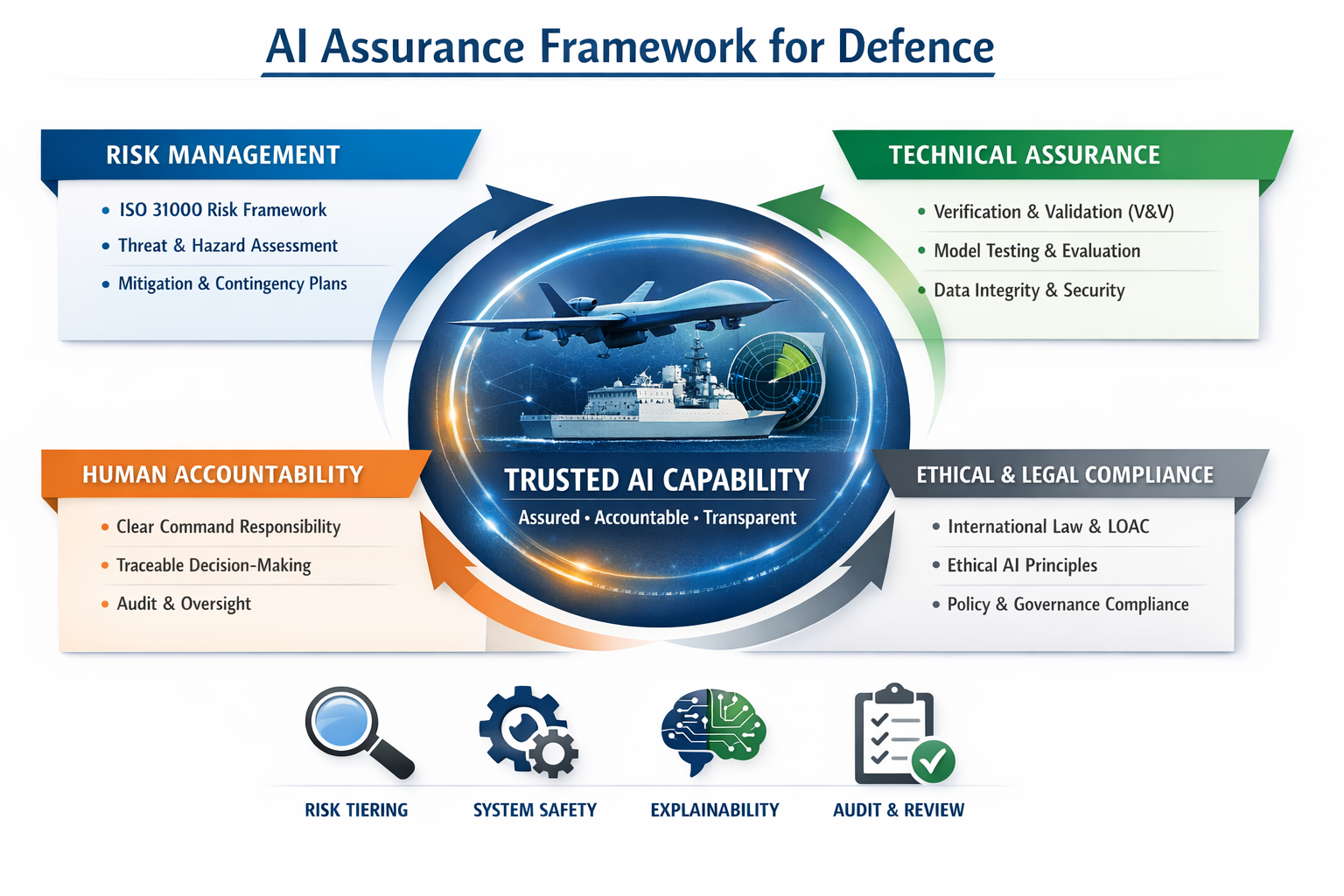
To operationalise responsible AI, Defence programs require an integrated assurance framework:
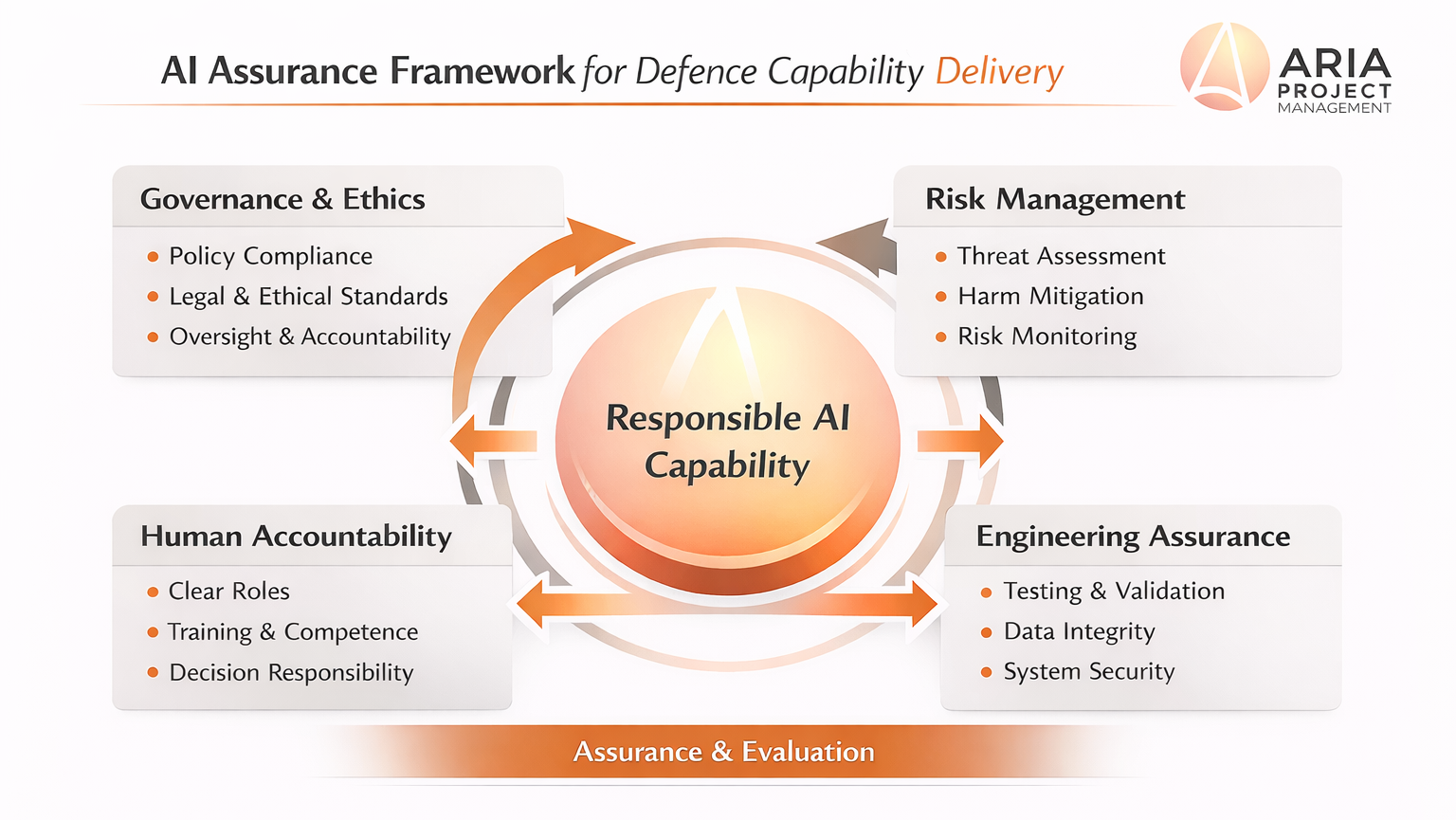
Figure: AI Assurance Framework for Defence Capability Delivery (ARIA Project Management Solutions)
This framework reflects the convergence of governance, risk, engineering assurance, and accountability required to deliver AI-enabled capability within Defence environments.
Aligning with International AI Standards
The responsible use of AI within Defence environments does not occur in isolation. It must align with emerging international standards that provide structured governance, assurance, and certification pathways.
The release of ISO/IEC 42001:2023 – Artificial Intelligence Management Systems (AIMS) represents a significant step in standardising how organisations develop, deploy, and manage AI capability.
A Structured Approach to AI Assurance
ISO/IEC 42001’s Plan–Do–Check–Act model can be applied across the full AI capability lifecycle within Defence programs:
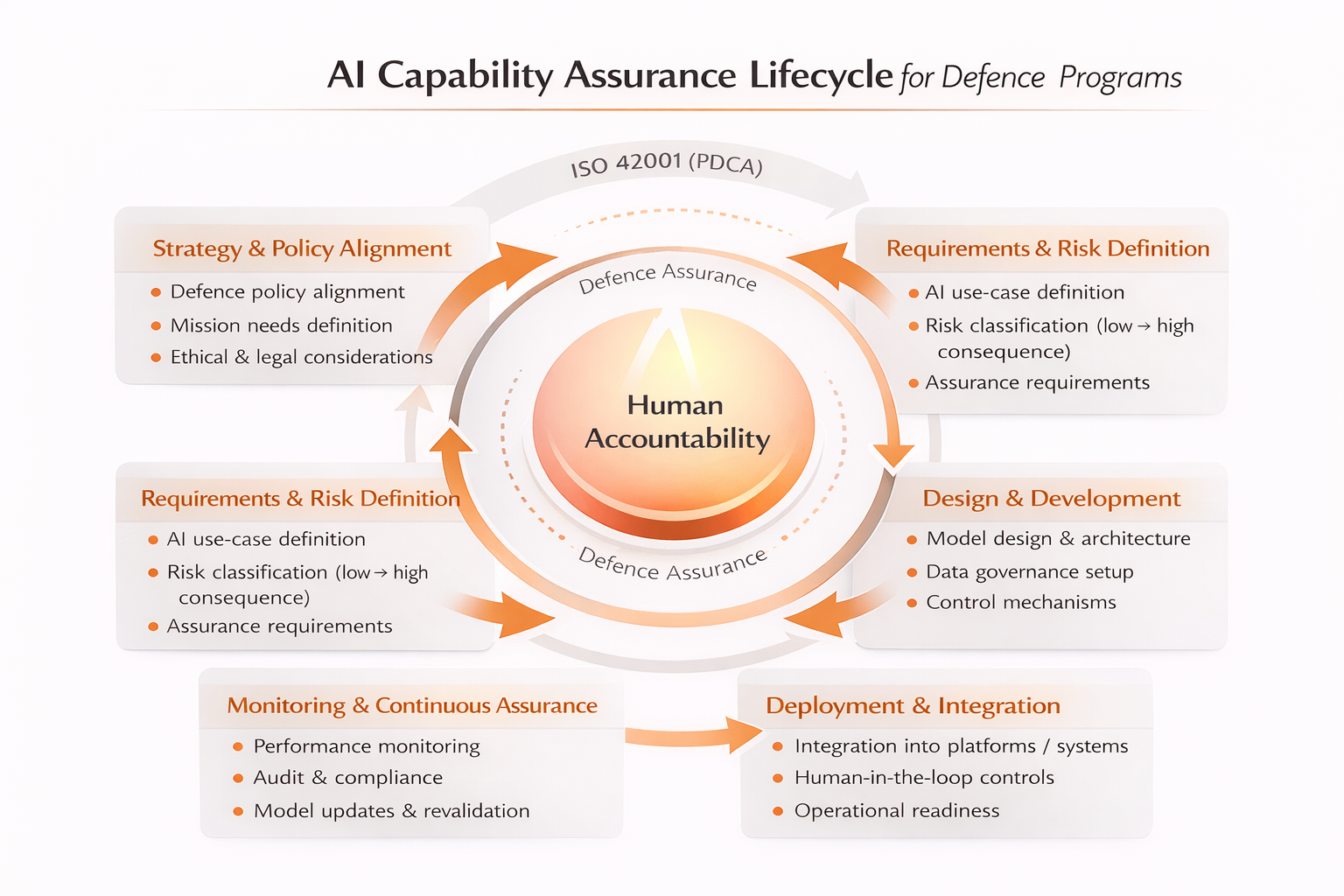
Figure: AI Capability Assurance Lifecycle aligned to ISO/IEC 42001 and Defence delivery environments
ISO/IEC 42001 establishes a certifiable management system framework to ensure AI systems are:
- Responsible and ethically governed
- Transparent and auditable
- Aligned with risk management principles
- Continuously monitored and improved
The standard adopts a Plan–Do–Check–Act (PDCA) model, supporting continuous improvement across the AI lifecycle:
- Plan → Define AI objectives, risks, and governance structures
- Do → Implement AI systems with appropriate controls and safeguards
- Check → Monitor performance, validate outcomes, and assess risk
- Act → Continuously improve systems and governance frameworks
This lifecycle aligns directly with Defence expectations for assured capability delivery, technical regulation, and sustainment.
Bridging Defence Policy and ISO 42001
There is a strong alignment between Defence policy settings and ISO/IEC 42001 principles:
| Defence Policy Requirement | ISO 42001 Alignment |
| Risk-based approach | Formal risk management framework |
| Human accountability | Defined governance and accountability structures |
| Transparency and auditability | Monitoring, reporting, and audit requirements |
| Assurance of outcomes | Validation, testing, and continuous improvement |
This alignment provides a practical pathway from policy intent to implementable systems.
Beyond 42001: The Emerging AI Standards Ecosystem
ISO/IEC 42001 sits within a broader ecosystem of AI standards, including:
- ISO/IEC 38507 – Governance implications of AI
- ISO/IEC 42006 – Certification bodies for AI management systems
- ISO/IEC TS 42119-2 – Testing and evaluation of AI systems
Together, these standards establish the foundation for a globally aligned AI assurance and certification environment.
Why This Matters for Defence and Industry
Alignment with ISO/IEC 42001 is not simply about compliance—it is about enabling:
- Trusted and responsible AI capability
- Integration into regulated Defence environments
- Alignment with procurement and certification pathways
- Confidence across stakeholders, regulators, and operators
For Defence programs, this represents a shift toward standardised, auditable, and certifiable AI capability delivery.
Implications for Defence Acquisition and Sustainment
The policy—supported by emerging standards—will increasingly shape:
- CASG acquisition frameworks
- Technical regulation regimes (seaworthiness, airworthiness)
- Systems engineering and V&V processes
- Sustainment decision-making systems
AI-enabled systems will need to meet the same standards of assurance as traditional capability—while also addressing new dimensions of complexity and uncertainty.
ARIA’s Perspective: Enabling Assured AI Capability
At ARIA Project Management Solutions, we see responsible AI not as a constraint—but as an enabler of trusted capability.
Our role is to bridge the gap between:
- Emerging AI technologies
- Defence governance and assurance frameworks
- Real-world program delivery
We support government and industry partners to:
Integrate AI into Complex Programs
- Align AI capability with mission and system requirements
- Embed AI within engineering and program baselines
Establish Governance and Assurance Frameworks
- Apply ISO 31000-aligned risk management
- Align with ISO/IEC 42001 AI management system principles
- Define accountability and decision traceability
- Support auditability and compliance
Deliver Operationally Trusted Outcomes
- Ensure AI-enabled systems are fit-for-purpose, verifiable, and defensible
- Support integration into sustainment and lifecycle environments
The Strategic Opportunity
Defence’s policy does not slow AI adoption—it raises the standard.
Organisations that succeed will be those that can:
- Translate policy into practical delivery frameworks
- Integrate AI into existing capability systems
- Demonstrate assurance, accountability, and trust
This creates a clear opportunity for industry to move beyond experimentation and deliver AI-enabled capability at scale.
Deliver AI Capability with Confidence
ARIA Project Management Solutions supports Defence and Industry partners to integrate AI into complex programs with assurance, accountability, and operational trust.
Conclusion
The question is no longer whether AI will be used in Defence.
The challenge is:
How to deliver AI-enabled capability that is assured, accountable, and operationally trusted
Position Your Organisation for Responsible AI
ARIA works with Defence and industry partners to integrate emerging technologies into funded, deliverable capability outcomes.
If your organisation is navigating AI adoption within Defence environments, we can support:
- AI governance and assurance
- Program and systems integration
- Risk-based delivery frameworks
Leave a Reply